
December 29, 2009
Tonight marks a big milestone in my observations of Charles and Sarah. Tonight makes it four years that I have been consistently watching these amazing owls. Those of you who have been on my e-mail list for some time received an e-mail last year, that I will quote in full below, marking the third anniversary of these frequent and detailed owl observations. But before I quote that e-mail, I want to share with you some information gleamed from the photo and video recordings I make when watching the owls. From December 28, 2008 until December 29, 2009, I have:
* I made 268 observation trips to the park to watch these owls
* This means that I got to the park rate 73% of the time over the course of the year
* Which yielded a per week rate of 5 times per week.
* Of the 268 observation trips I made, on 260 of them I saw the owls, which makes my success rate 97% (the owl mysteries of November and December 2009 brought this rate down)
* I went to the park the most in March 2009, 27 times
* I went to the park the least in February 2009, 18 times (not too shabby considering that I was out of town for 5 nights of this 28 day month!)
* The most nights I went in a row was in November 2009-12 nights in a row, followed by January 2009-10 nights in a row. 4 months had7 nights in a row.
All told, I have spent hundreds of hours in the park watching the owls. I am on my second pair of boots and my second backpack in the course of this year. I have taken thousands of pictures and videos. I have sent scores of e-mails and made scores of blog posts. I have seen the owls make predatory attempts, successful and not on:
* bats (species undetermined)
* Canada Geese
* Wood Ducks
* Raccoons
* Mallard Ducks
* Eastern Cottontail Rabbits
* unidentified insects
* American Robins
* Black-Crowned Night Herons
* Eastern Grey Squirrels
I have seen the owls: mate, nest, raise two unique youngsters (Art and Mo), groom, stretch, hunt, fly, expel pellets, defecate, duet, drink water for the first time (I saw Sarah do this tonight!), loose a momentous part of their territory and life history, get chased out of trees by Eastern Grey Squirrels, go further west and southwest then I have ever seen before, stay in post-perch trees for record lengths of time (tonight I watched Sarah stay in the same spot of one tree for 96 minutes shattering a very recent record by Charles of 75 minutes), and much more.
I have led two formal owl prowls and several informal ones, been consulted by professional naturalists, and have shared the joys and wonders of these owls with friends new and old. I have sweated gallons and felt my fingers and feet go numb, I have prepared hundreds of bottles of water, and have read and re-read countless books and articles on owls.
Thank you so much for reading and for your encouragement and support!!
Here is what I sent to my e-mail list last year-it still holds true!!
While I continue to write updates about the doings of Charles and Sarah over the past week or so, I wanted to write something this evening to commemorate and celebrate a milestone. This evening marks the third anniversary of when my observations of the owls went from occasional to highly consistent.
If I may digress, here is a little background. I first saw owls of any kind in Forest Park in August/September 2005 on a walk home from work. The owls were Great Horned Owls and were quite likely the owls that I have come to call Charles and Sarah. This late summer-early autumn evening owl observance was amazing. I saw and heard both owls hoot and fly and I even saw one chase a Great Blue Heron. I was instantly hooked.
I began delving into the literature on owls and making pilgrimages at dusk to where I first saw the owls; the wetlands area near the Franz Siegel statue. I met with little success but with just enough to keep me encouraged and returning in hope of further owl observations. I was joined on some of these excursions by either my girlfriend Wendy or my friend and colleague, Mark Rank. Unfortunately these joint excursions were unsuccessful. As Mr. Murphy and his eponymous law would have it, I would only see the owls, albeit briefly and inconsistently, when alone.
Then one day in the fall of 2005, I got a huge tip that would change my luck immensely. I was speaking with a then PhD student; Bipasha Biswas who I knew visited the park regularly. I brought up the owls and she remarked that she saw them with great regularity in and around The Boathouse. I thanked her for the information and shifted my attentions to The Boathouse. My attentions were soon rewarded and my success rate in seeing the owls went from a paltry 1 out 10 to a more substantial 3 out of 10. I even had co-observers of the owls as Wendy finally saw one on a cold, rainy evening. The observations remained short and inconsistent but progress had occurred.
As the fall semester of 2005 came to an end, I looked forward to a healthy amount of vacation and the additional owl searching time available to me. On December 29, 2005, I approached the area near the Boathouse between Government Drive, Pagoda Circle and McKinley Drive, where many of my recent observations had occurred. My devotions were soon rewarded and then some as I saw a Great Horned Owl fly into a hollow between two-thirds and three-quarters of the way up an immense deciduous tree.
With great excitement, I watched the owl settle into this hollow, which encapsulated the owl in a way that seemed correct and comforting. The owl dozed for a while and then began to groom, stretch and then hoot. I was spellbound. The level of intimacy and detail with which I was able to observe the owl surpassed every previous sighting.
The owl then flew off to one of four large deciduous trees in close proximity to each other (now known as The Four Trees) and began to call some more. After substantial hooting, the owl flew off at a rapid pace and disappeared from sight. I could not believe my luck. I hoped that this hollow would turn out to be the very thing I had been looking for; a specific place where an owl regularly spends significant amounts of time, a place that can be viewed with consistent success.
I walked home briskly to share the news with Wendy. As I walked home, I thought of a name for the owl. The name Charles came to mind quickly and instinctively. For one, I knew Wendy would find it irresistibly adorable. Two, the name Charles seemed to fit the simultaneous common and special reputation of the Great Horned Owl as the name has a broad range of associations from the names of royalty to the names of everyday people.
True to her nature, Wendy was ecstatic and listened as I went on in great detail about the hollow, the owl and everything it had done. I re-read relevant portions of the few owl books that I owned at the time and I could not wait for the next day to arrive so I could seek Charles out anon.
The next day as I had hoped, there was Charles in the hollow! For the second evening in a row, I saw him doze, wake up, doze again, wake up again, groom, stretch, hoot, fly a short distance, hoot and then fly out of sight. My success rate now skyrocketed from 3 out of 10 to 8, 9, and 10 out of 10! For many months now, I have been at a point that if I arrive with enough time before sunset (preferably 30-45 minutes), I will see one or more of the owls.
After December 29, 2005, everything just snowballed. I began to see a second owl more often and after much confusion (self-caused) I was able to determine that Charles was indeed a male and the second owl a female. The second owl was soon named Sarah after I saw the two owlets they had in the late winter/early spring of 2006. I watched the owlets grow up over the spring, summer and early fall and then saw Charles and Sarah begin the build-up to mating in the fall of 2006. On December 24, 2006, I saw Charles and Sarah mate for the first time and tonight I saw them mate for the sixth time in the last ten days.
In the three years since the great, fateful day of December 29, 2005, I have seen an amazing panoply of Great Horned Owl behavior; everything from hunting to child-rearing to moments of danger to moments of comedy.
In conclusion, I would like to make a few acknowledgements. Firstly, to the person who gave me such a huge tip on where to find the owls, Bipasha Biswas. Bipasha, the information you gave me has yielded rewards I cannot fathom. It is important to note that Bipasha has gone from PhD candidate to now being Dr. Biswas, Assistant Professor of Social Work, Saint Louis University. Secondly, to all of you: you have read my words, heard my words, viewed my pictures and videos, gone on owl prowls, and kindly given your praise, interest and encouragement. I thank you for your patience and kindness. The biggest thanks of all go to my girlfriend, Wendy. She is beyond encouraging. She listens to detailed descriptions to countless evenings of owl observations, she reads and proofreads my scribblings, she finds countless books, articles and references to owls, she helps me with physical items to assist me in my owl observations: clothing, optics and cameras and when the weather is sufficiently decent, she comes out for an owl prowl. Thank you, Wendy and thanks to all of you for your continued support and encouragement!
Tuesday, December 29, 2009


Sunday, December 20, 2009
3rd mating observed this season!
December 20, 2009
After an interesting but fragmented week of owl sightings:
After an interesting but fragmented week of owl sightings:
- saw them on Sunday, did not see them on Monday
- saw them and observed them mate on Tuesday
- saw only Sarah on Wednesday
- did not get to the park (holiday part at work) on Thursday
- saw only Charles on Friday (but new owl friends Shelly and Mark saw both of them)
I was more than ready to get to the park yesterday (Saturday, December 19) well before sunset and find both Charles and Sarah. It was grey, cold and windy and there were patches of snow on the ground from the flurries that hit the area on Friday night. I went to The Quintet Conifers and I found Sarah in the conifer to the right of Charles' Favorite Conifer. I looked for Charles in this conifer but he was not there. I heard Sarah hoot briefly and I my have heard a one note hoot from Charles so I looked extra carefully for him. I altered my position slightly and saw that he was in the same tree as Sarah! They do not use this conifer a great deal but enough to make it worthwhile to examine this tree carefully. It is always special to see them perched together in the same tree. They have perched together more often in the past few months than in any other time during my observations.
While it was great to see them in this tree, it was hard to find clear angles for to take pictures of them. They each varied their positions a little and did some grooming. Charles did an Escalator Stretch and later a Double-Wing Stretch. Sarah moved again and they began to duet in full. Initially, they had their backs to each other but then Charles moved above and to the right of Sarah.Sarah made a short flight to an exposed branch on a deciduous tree between The Quintet Conifers and The Trio Conifers. The duet paused briefly but resumed again. The wind was intense, making my eyes water and pushing Sarah in mid-flight as she flew to another deciduous tree. After another pause in the duet, perhaps to the wind, the duet continued and at a faster pace and with more intensity.
Charles flew out of The Quintet Conifers to a deciduous tree and continued to hoot. I thought the duet would continue as it had not seemed to reach its peak. On scale of 5 the duet was at a 3 but they had started at 2. The duet did continue but before it became a 4 or 5, which usually proceeds mating, Sarah flew over and joined Charles in the same tree. Moments later they mated as you can see below.
This was the first mating of the year that I had seen and I was thrilled that I was able to film it and at a close distance. This was also the earliest in the evening that I had seen them mate so far this year.
So, how do owls mate? The best way I can find to answer this is to quote, at length, an excellent description from page 151 of the superb book Owls of the United States and Canada by naturalist and nature photographer Wayne Lynch, The Johns Hopkins University Press, 2007:
“Birds, by comparison, are much less athletic in their quest for insemination. To begin with, birds don’t have a penis, although ratites such as the ostrich, emu and greater rhea, as well as storks, flamingos and geese have a thickening wall of their cloaca that can become erect and function like a penis.
Without a penis, how do birds stay linked together long enough for insemination to occur? Owls and other birds have perfected the maneuver called the “cloacal kiss” – the cloaca being the terminal portion of a bird’s intestinal tract into which the kidneys and reproductive tracts also empty. During mating, their cloacae pout and kiss for three or four seconds-just long enough for millions of sperm to be passed to the female…Sometimes the male brings a present of prey, as Snowy Owls and Great Horned Owls occasionally do, but it is not a necessity.
…During mating, male owls of all species balance lightly on the female’s back. To keep their balance, they may extend their wings slightly and gently grasp the female’s nape….Once the cloacal kiss is completed, the male quickly dismounts. The pair may shake and fluff up their feathers, rub their bills, together, preen each other briefly or simply fly apart.”
Charles flew off a modest distance to a large deciduous tree in the eastern third of The Wooded Area. Sarah remained in the same spot for several minutes before flying off towards The Four Trees. With Sarah out of sight, I watched Charles for several minutes before he made an impressive flight out of The Wooded Area. He dove low and then pulled up with remarkable athleticism and popped out over the trees on the eastern edge of the area.
I went around to reacquire them, hoping I could find them in some of their favorite haunts in the area east/northeast of The Wooded Area. No such luck-they had gone further than I had hoped. I continued in the same direction checking out additional further haunts around Deer Lake, the wetlands and the waterway but without success. As my time was limited due to a social engagement that evening, I concluded my search and returned home. I was a little bummed to not have reacquired them but I was ecstatic to have finally seen them mate this year.
Wednesday, December 16, 2009
2nd mating observed this season!
December 16, 2009
I got to the owls territory 20 minutes after sunset yesterday. I did not hear any hooting so I had to decide where to start my search. Since they have been using The Hilly Wooded Area a great deal recently, I decided to begin there. ESL (Experience, Skill, Luck) paid off again and moments later I found Charles in one of his favorite hunting perches in this area. I have found him in this tree several times in the last few weeks. Interestingly, he is always in the same section of the tree but his exact spot varies.
I watched him in this spot for seventy-five minutes. This duration likely exceeds and certainly meets the longest time I have seen him or Sarah stay in one tree after they leave their daytime perches. And yes, it was cold. When I got home, the weather report indicated that the temperature was 23F but felt like 14F. While watching Charles in this perch, I changed my observation post a few times to try and get some blood flowing. I was happy to move even more when I saw him fly off west, brilliantly illuminated by the streetlights as he flew over the road.
Charles did not go far as I heard him hoot in a mixed glade of conifers and deciduous trees close to The Hilly Wooded Area. His hoots resounded loudly through the still night air and even through my hat and balaclava to reach my ears. I could not see him for a while until I tried another angle and found him silhouetted in a large deciduous tree. He flew another short distance and continued hooting and again I had to find the right angle before I could see him, this time in a conifer.
I hoped his hooting would bring Sarah into the area and that they would do some Peaches & Herb duetting as I mentioned in my last post. I did not have to wait long at all. From The Hilly Wooded Area, I heard a strange animal call like a yelping meow followed by the dulcet tones of Sarah hooting. I do not know if Sarah made the odd call but Charles responded to her hooting immediately. They began a nice duet that accelerated in pace. I could not see Sarah but it sounded like she was close to The Possible Nest Tree.
Sarah was calling to the left of me and Charles to the right so I figured that I would likely see them if one flew over to join its mate. I was wrong. The next thing I knew Sarah was over in this mixed glad duetting rapidly and intensely with Charles. I did not see her fly there at all. Charles had changed his position slightly but I could not see him or Sarah. Mere seconds later they mated. I did not see them mate but Charles made the high-pitched call he makes while they mate. Sarah hooted while they mated; one of a few times that I have seen her hoot while Congress was in session. Listen to the video below and at the 41 second mark you can hear them mate as Charles makes his high-pitched call.
Just after mating, Sarah flew, again unseen by me, back to The Hilly Wooded Area while Charles remained, for a while, in this mixed glade. I went to reacquire both of them but was unsuccessful. I decided to head home, grateful to have the blood flowing at an even great rate, especially to my cold feet!
It was amazing to observe them mate again. It was especially interesting that I did not see Sarah at all; I only heard her. Instead of flying from place to place, it seemed like she teleported instead! I'm glad I endured the cold watching Charles. If had not been patient paid I would not have been able to observe Sarah and the second mating of the season. That said, I was glad to return to my warm home and tell Wendy all about what I had observed!
Friday, December 11, 2009
Even more owl mysteries and the first mating of the season!
December 11, 2009
After an astounding evening on Monday 12/7 (fear not, there will be a post about it), I did not go to the park on Tuesday 12/8. It was pouring rain, cold and generally unpleasant. I returned to the park on Wednesday 12/9 and so did the owl mysteries.
Just as I leaving work, I saw my friend and colleague Timothy Hower leaving as well. I called his name and waved hello. He graciously asked if I wanted a lift to the park and I did not hesitate to accept. With sunset so early these days, every second counts. We got to the owls territory, I thanked Timothy and made my way to The Crossroads Conifers and The Quintet Conifers. No Charles, no Sarah to be found. Even though it was a few minutes after sunset and overcast, it was more than light enough to find them. I looked around The Wooded Area and a little around The Hilly Wooded Area but without success.
I noticed that the southern portion of The Wooded Area had been cleared within the last three days of Bush Honeysuckle, an invasive plant. This work starkly altered the appearance of the portion of woods. While I'm glad that this work was done, I was and am concerned about the timing of the work and its possible impact on the owls. Great Horned Owls as a species and Charles and Sarah as individuals are highly adaptive critters but for this work to occur as mating season arrives is disquieting.
I spent the next hour looking around the core of the owls' territory and heading out west and north hoping to find them but without success. Like the other recent nights when I did not find the owls, I was (and am) at a loss for an explanation of where they had gone and why. Also in-keeping with the other nights of no sightings, I dreamt of owls that night.
Yesterday, Thursday 12/10, was a bright, clear and cold day and I arrived at the owls' territory a few minutes after sunset. I felt confident that the bright conditions would give me more time to find the owls before they went off to hunt. Once again, I could not find them. I thought I heard a hoot or two from far off in The Hilly Wooded Area but it was so vague, distant and inconsistent that I dismissed it. After perusing the nucleus of their territory I went west and north again but from a different point of attack than I had on Wednesday 12/9. It was stimulating to take this different tact but it was no more successful than the previous night.
I then headed northeast, stopping at some locations where I have reacquired the owls both recently and in years past. No such luck this night. Only going south remained, so I went in that direction resolving to conclude my search in The Hilly Wooded Area before heading home. I did not find them on my way to this area and once I arrived there, I only had a glimmer of hope that I would find the owls.
The Hilly Wooded Area is one of the more challenging areas in which to reacquire and observe the owls. It is not the most densely wooded area in the park but the trees are large enough in number and size that there many places for the owls to perch. The large number of trees dump lots of leaves, twigs and branches on the floor making a stealthy approach difficult but not impossible. The frozen ground last night made the leaves extra crunchy and loud. Over the years I have learnt some of their favorite hunting perches in this area and while this helps, it is not a guarantee of success.
I went to a couple of these perches and found no owls but as I came near another perch, I flushed an owl and it flew off past me going north. In the dim light I was pretty sure I saw it pull up and land 80-100 yards from me. Judging by the size of the owl, I decided it was Charles. I thought briefly that it may have been one of the neighboring Barred Owls but I dismissed that thought.
Faint hooting began to waft through The Hilly Wooded Area. Since I was wearing a balaclava and a hat over that, my hearing was limited. I removed my hat and I could hear the hooting more clearly. I walked towards the hooting straining to hear it over the crunching leaves. As I got closer I identified the hooting as Charles' and then I began to hear Sarah hoot in return. In the last week or so, I have seen Charles and Sarah do this post-dusk hooting several times. I've begun to think of these singing sessions as Reunited Duetting or in my sillier moments, as Peaches & Herb Duetting.
I found Sarah hooting in a tree near The Possible Nest Tree a modest distance from where Charles' hoots originated. Moments later, she flew off towards Charles and I heard the distinctive high-pitched call that Charles likely makes when they mate! Although I did not see them mate and while I have heard this call twice outside of the mating season, given the givens I'm sure that they mated! Amazing!!
The only downside that the batteries on the camera with which I shoot video died and I was scrambling to replace them when they mated, so I missed capturing the high-pitched mid-mating call. D'oh!
It was 6:15pm when they mated, over an hour and a half after sunset and one of the latest if not the latest times I have ever observed them mate. This is the earliest in the year I have ever seen them mate. I wonder if the sudden onset of bitterly cold winter weather has had any effect on the timing of mating. In 2006, I first saw them mate for the first time on 12/24, in 2007 on 12/14 and in 2008 on 12/19.
I have been extremely privileged to observe Charles and Sarah mate now 30 times over the past four mating seasons and I hope to continue to add to that figure this year and beyond. It is a privilege not only to have observed such intimate behavior but also because the behavior has been seen relatively few times and only recently described. Mating was first described in the scientific literature in 1998, an especially late date given the fact that Great Horned Owls are the most widespread, commonly found owl in North America. This late description of a key piece of behavior underscores the challenges of observing an animal that is crepuscular and nocturnal, extremely well-camouflaged, and flies silently.
Thrilled at having first found the owls and then observed mating for the first time, I went home with a smile on my face and shared the news with an estatic Wendy.
Monday, December 7, 2009
Thanksgiving owl mysteries continue!
Monday, December 7, 2009
After a week of some amazing owl behavior, which included duetting in and around The Possible Nest Tree early in the week and each of them going after a raccoon on Friday, December 4, Charles and Sarah disappeared and reappeared once more.
On Saturday, December 5, I was in Kennedy Forest where I ran into Barb Brownell and Chris Gerli.

We were all looking for other owls (more on that in a soon-to-be completed blog post, I promise) so we looked together. After this search concluded and they showed to some of the spots where they had followed these owls, we jumped in their car and headed off for the territory of Charles and Sarah. Just like Thanksgiving, we could not find the owls.
Barb and Chris could only stay for a while but while they were there, we could not find the owls. On my own, I went looking around all over just as I had on Thanksgiving and with the same lack of success. I did not see or hear anything that indicated they were in their area, My friend Edward Crim and his family looked for the owls earlier that day and he described in his blog that he too was unable to find them. I felt slightly vindicated that many well-practiced eyes and ears drew a blank but I was still puzzled and concerned about where the owls were. Also like Thanksgiving, it was a beautiful night and the owls made an appearance in my dreams that night.
 On Sunday, December 6, I headed to the owls' territory as soon as I arrived in the park. Exactly like the day after their Thanksgiving disappearance, Charles was back in his favorite conifer and Sarah was once more in her new perch in The Crossroads Conifers.

 Sigh. Why had they left? Where did they go? When did they leave and when did they return? Why did they not leave a note (again)? Plenty of questions, no answers.
Having relocated the dynamic duo, I had a little more time before sunset so I went to the other portion of The Successional Woods. On Saturday, November 29 I heard a Barred Owl call once from that area. I have found Barred Owls in this area before but it had been a while since I had found them. I went to one of the few glades where I had luck finding these owls before and just as I began to approach this area, two large birds went flying away at a rapid rate. I was able to identify one as a Barred Owl and while the second bird was likely a Barred Owl, I saw it too briefly to absolutely positive. I tried to relocate them but without success. I headed back to The Wooded Area to watch Charles and Sarah.
I became concerned about Charles that night even after I found them. He and Sarah got a nice duet going. She flew from her perch in The Crossroad Conifers to the top of the bare tree within The Quintet Conifers.
 Sarah glided off southeast, passing by me in heart stopping fashion at eye level and within fifteen feet horizontally. Charles flew out of his favorite conifer but only a short distance to a nearby tree. Minutes he later he again flew another short distance and his landing was a little awkward. Even taking into account that short flights and their landings can be awkward, it still seemed odd and that he flew such a short distance and not to one of his more typical fly-to perches, which are further away. I began to wonder if he had been injured.
I watched him in this second perch from a close but safe distance as night descended. After 30 minutes of minor head movements and no hooting, he did a double wing stretch and groomed for a half minute. His movements resumed being limited to small head movements. I resolved that if he did not fly after being in this perch for an hour, then I would gently flush him from his perch and watch him fly to see if he was in good shape or not. Meanwhile, my fingertips were investigating the possibility of emancipating themselves from the rest of me. While I was warmly dressed, standing still on a cool evening makes keeping toes and fingers warm an all too palpable challenge.
 As the hour mark neared, he expelled a large pellet but still did not hoot. If a pellet is on its way up it will serve as an impediment to hooting. Usually, once a pellet is expelled, they will resume hooting, often with gusto. Charles then flew off , making another short flight. My view of the flight was partially obscured but what I saw was a solid flight. Still, I wanted to be certain he was okay. I walked directly to his perch and only as I got to within a few feet of him did he fly off east. Thankfully, it was a long, high and powerful flight that took him out of The Wooded Area. I felt relieved that he was okay and I went to reacquire him.
I found Charles in one of the large Cottonwoods between McKinley Drive and The Muny. He began to hoot in a loud, strong voice, which reassured me even more. Further reassurance came as he flew off southwest into The Hilly Wooded Area. Satisfied that he was fit as a fiddle, I headed for home. My route home took me through The Hilly Wooded Area where I found him once more. I watched him for a moment more before he flew off south. I could him hear him hoot from from The vicinity of The Possible Nest Tree. I made my home eager to regain feeling in my fingertips and still curious about the owls disappearance and reappearance.
Sunday, November 29, 2009
Thanksgiving owl suprises
November 30, 2009
Thanks to benevolent bosses, I was able to leave work at 2pm on Wednesday, 11/25. I had debated about where to go before I went to Charles and Sarah's territory. I finally decided to head into Kennedy Forest on the west side of the park and then go see the Dynamic Duo. Just short of the summit of the hillside along the southbound Skinker Boulevard, I turned into the forest. I stopped and looked to see if any Barred Owls had returned to some previous perch/roost sites. They had not so I continued on eastward into the forest.
I took one of the non-paved paths that wanders through the forest. As I walked on a northerly portion of this patch I saw some whitewash (bird droppings) on the ground. I looked around the vicinity and I saw some more whitewash. The volume of whitewash was enough to indicate that this was the perch site of a large bird, possibly a large bird of prey.

I looked up and directly above me was indeed a large bird of prey. I was 99% certain it was a Great Horned Owl but I could not see its head and face. Walking carefully to a better vantage point I saw the tell-tale tufts and massive eyes of a Great Horned Owl. Bloody hell.
 While I was thrilled to find this owl, I want to emphasize that I did not stumble upon this owl by a mixture of accident and skill alone. I knew that this area had a recent owlish history. In August, one of my owl friends Christine e-mailed me that she had seen a Great Horned Owl in this area. After receiving her e-mail, I searched in vain for an owl amongst the near jungle-like foiliage that had flourished with the record rainfall we had this summer. I had already had my own observations of a pair of Great Horned Owls for a few weeks in February and March of this year in this very section of Kennedy Forest. As quickly as I found them, this pair disappeared. Given the owl occupancy in this stretch of woods, I always keep my eyes peeled for any all signs of an owl when I'm there.
Thrilled to have found a Great Horned Owl again in Kennedy Forest, I called two of my owl friends to see if they were able to come out and see this gorgeous owl. First on the list alphabetically by last name was Edward Crim, photographer extraordinaire of Forest Park 365 fame. Edward was excited to hear about the owl but was had already made his daily sojourn to the park. I let Edward know where the owl was and that it was located where we saw an owl the first time we met back in March. Next on the call list was the aforementioned Chris Gerli. He too was quite chuffed to hear about the owl. He hoped to come out if the day's work finished early and I gave him directions on where to find this owl.
As I called Edward and Chris the owl began to hoot. The low, long notes the owl made indicated that it was a he; a male! I noticed that the hooting was on the tentative side, not quite fully formed. The male owl of the pair I found in this same area in February and March hooted in a similarly immature fashion as well. I went back to watch the owl hoot and was pleased to see that he had altered his position in the tree and was much more visible.

I was struck by his extra-large white bib under his chin and the edge of immaturity in his plumage. He looked and sounded like a sub-adult still on the cusp of full maturation. He kept up a steady rate of hooting and it struck me that he was hooting quite early in the day. It was well over an hour before sunset and generally Great Horned Owls begin to hoot closer to sunset than this chap was.
Filled with excitement about this new owl I headed off to see Charles and Sarah. Less than a third of the way there, my cell phone rang with Chris Gerli on the line. Work had finished early and he wanted to find this owl. We struck an easy bargain: I would show him this owl for a short and then he would drive us to the territory of Charles and Sarah. Chris was along shortly, I piled into his van and we made our way back to the forest.
The owl was still hooting and we could see him easily. As we made our way to our vantage point we saw two people coming the other direction. Through waves and hand signals it became clear that they knew an owl was in the vicinity. They and their extraordinarily well-behaved dog joined us and we exchanged hellos and names. Sally and Patience had been watching this owl for the past three nights and were glad that we could identify the species for them. Chris and I were glad to have some more information about how long this owl had been there. We told them about Charles and Sarah, several aspects of the natural history of the species and I mentioned that they (and anyone) could contact me via this blog. Just before Sally and Patience departed, the owl flew off west and continued to hoot after he landed.
Chris and I got a good look at where it had landed and we headed off to reacquire him. Then things took another turn. The owl continued to hoot and then we heard a response. It was a Barred Owl calling from a southwesterly direction. The Great Horned Owl hooted again and the Barred Owl replied in kind. What became odd was that out of four hoots by the Barred Owl, one sound like a text book Barred Owl call (often rendered as "Who cooks for you? Who cooks for you all?") while the other three sounded like a melange of a Barred Owl hoot and that of a Great Horned Owl. The cadence was Barred Owl like but the tonality had the smooth woodwind sound of a Great Horned Owl. Chris and I were not surprised though no less thrilled to hear a Barred Owl as we both found them in Kennedy Forest over the years. We reacquired the Great Horned Owl and watched him hoot at close range. My apologies for the lack of video footage but I had a memory card error that day and the footage I took was unusable. D'oh.

Between our great chat with Sally and Patience and reacquiring Charles and then looking for the Barred Owl, Chris and I spent more time in this vicinity than we had expected. After discussing the possible location of the Barred Owl, we jumped in his van and headed for the territory of Charles and Sarah. We only saw Charles for a short while and on the following day, Thanksgiving, I was not able to get back to Kennedy Forest or find Charles or Sarah as I described here.
Chris Gerli and Barb Brownell found the owl on Thanksgiving, 11/26 and they observed it hooting in the bright afternoon sun for at least half an hour. On Friday and Saturday, November 27 and 28, I started my time in the park by looking for the Great Horned Owl in Kennedy Forest. On both days, I was able to find this owl brilliantly camouflaged in the same vine covered fork between two large branches. This owl was so well-hidden that on both days, an Eastern Grey Squirrel jumped right over the owl to get to from one fork of the tree to the other without seeming to notice this parked predator. I heard the owl hoot briefly on Friday but not at all on Saturday. The day time hooting, well before dusk, is puzzling. While I have not been able to do an extensive perusal of the literature, I do not recall previously reading anything wild Great Horned Owls hooting in the afternoon like these owls.
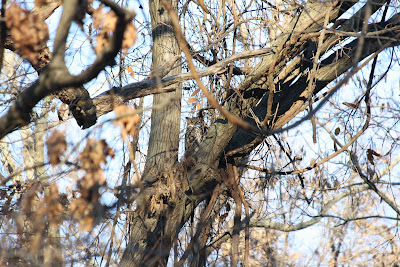
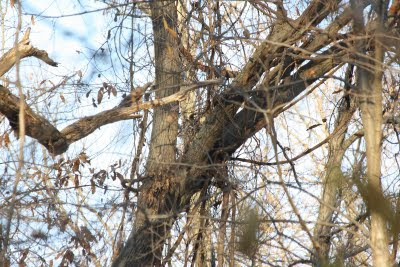
On Saturday, 11/28 a new wrinkle in this story emerged. Taking advantage of the unseasonably warm weather, up to 70 F, Chris Gerli and Barb Brownell headed to Kennedy Forest. Their goal was to watch the owl in depth and to gauge his flying skill and maybe even look for signs that it was Mo or Art; one of the owlets that Charles and Sarah had this past nesting season. They called me as I was watching Charles and Sarah. I listened to their intentions and wished them well.
Their next call came a short while later. Not only had they found the male owl and heard it hoot but they also heard the distinctive reply of a female Great Horned Owl before finding this same female! The two owls began to duet and fly to different singing perches with adult aplomb. This behavior demonstrated to Barb and Chris that these were adult owls that had paired up or were actively in the process of doing so. Chris and I spoke twice more on the phone that night and his breathless excitement was infectious. The owls continued to duet and fly south until Barb and Chris lost them as the owls headed off in southeasterly direction.
I looked for these owl on Sunday 11/29 but did not find them at all. I debated looking for the owl on Monday 11/30 but decided instead to hit some recently unvisited parts of the park such as the prairie-savanna and waterway around Steinberg Ice Rink.
I met Chris Gerli and Barb Brownell looking for this owl on Saturday 12/5. This was the first time we had been back to this area since 11/28 and 11/29, respectively. We again did not find the owls or any very recent evidence of them such as fresh whitewash or pellets. Had the owls left or where they in another part of the park? So far, we do not have further information.
So now the big question is who are these Great Horned Owls in Kennedy Forest? Several scenarios exist:
To look at these possibilities, let us review what owlets of the species do when they leave their parents' territory. Great Horned Owls are remarkable parents, mating, nesting and hatching in the depths of winter. They do this because it takes so long for the owlets to mature and become independent. It is also thought that the owlets' efforts at hunting coincide with the arrival of more prey, especially the more inexperienced and thus vulnerable offspring of the owls' prey. After 5 or more months of careful care by the parents, it is time for the owlets to go out on there own. The parent owls stop feeding the owlets and will even chase them out of the parents territory. In describing the slow maturation of the young and the parents eventual cessation of care to human parents, the human parents side with the owl parents. I found this to be especially true if the human parents have children in their late teens and early twenties!
So what next for the owlets? Fundamentally, they have to survive and then work on finding and defending a territory before finding a mate and reproducing. Owlets are known to remain on the edge of the parents territory, the owlets' former home, while doing their best to eek out an existence without incurring the wrath of their parents. But the owls that are not able to raid the veritable fridge, head out away from their parents' territory.
With the exception of some of the northern subspecies of Great Horned Owls, which are forced to move south when prey populations crash, the species is sedentary. That is, if an individual owl is already established in a territory. For those that are not, they have to travel to find a place where they can survive and then work on progressing to territorial ownership, defense and then pair formation and reproduction. This first year or two is the only time of significant travel for most owls of the species.
So how far do they travel? As it is with many aspects of the natural history of Great Horned Owls, it can be hard to generalize. The species is the most widespread, commonly found owl in North America. Even the subspecies we have in Missouri, Bubo bubo virginianus has an immense range; all of the eastern U.S. and past the Mississippi River and portions of southern Canada. This immense range generates countless variables about the lives of owls in these different parts of the range. Great Horned Owls in Springfield, Missouri and Springfield, Florida and Springfield, New Hampshire will have some similarities but also in many differences in: what they eat, where they nest, when they nest, where they roost, population density, territory size and more.
While some studies focus on owls in a particular region or locale, other studies survey these more localized studies to come to more general conclusions. In his encyclopedic and sometimes slightly confusing book, North American Owls: Biology and Natural History, noted biologist Paul Johnsgard cites such a survey type of study that answers the travel range question nicely, "A study by Stewart (1969) of 434 banded recoveries from Great Horned Owls banded in various parts of their breeding range indicated that 93 percent were recovered within 80 kilometers (almost 50 miles) of the point of banded." So many owlets that have dispersed (left their parents territory) travel significant but not immense distances.
With all this in mind, that's why I spelled out the possible origins of these owls as:
Were these young adults stopping by Kennedy Forest as part of their process of establishing their own territory? Did they hear or otherwise run into Charles and Sarah and get the message that attempting to stay longer never mind establish their own territory in the area was a fool's errand? I hope to return to Kennedy Forest soon and try to find these owls again. My gut tells me that I will not find them again but I will keep my eyes and my mind open. Even if my owl friends and I do not find these owls again, this Thanksgiving owl surprise will be an interesting chapter in the annals of Forest Park Owls.
Thanks to benevolent bosses, I was able to leave work at 2pm on Wednesday, 11/25. I had debated about where to go before I went to Charles and Sarah's territory. I finally decided to head into Kennedy Forest on the west side of the park and then go see the Dynamic Duo. Just short of the summit of the hillside along the southbound Skinker Boulevard, I turned into the forest. I stopped and looked to see if any Barred Owls had returned to some previous perch/roost sites. They had not so I continued on eastward into the forest.
I took one of the non-paved paths that wanders through the forest. As I walked on a northerly portion of this patch I saw some whitewash (bird droppings) on the ground. I looked around the vicinity and I saw some more whitewash. The volume of whitewash was enough to indicate that this was the perch site of a large bird, possibly a large bird of prey.

I looked up and directly above me was indeed a large bird of prey. I was 99% certain it was a Great Horned Owl but I could not see its head and face. Walking carefully to a better vantage point I saw the tell-tale tufts and massive eyes of a Great Horned Owl. Bloody hell.
 While I was thrilled to find this owl, I want to emphasize that I did not stumble upon this owl by a mixture of accident and skill alone. I knew that this area had a recent owlish history. In August, one of my owl friends Christine e-mailed me that she had seen a Great Horned Owl in this area. After receiving her e-mail, I searched in vain for an owl amongst the near jungle-like foiliage that had flourished with the record rainfall we had this summer. I had already had my own observations of a pair of Great Horned Owls for a few weeks in February and March of this year in this very section of Kennedy Forest. As quickly as I found them, this pair disappeared. Given the owl occupancy in this stretch of woods, I always keep my eyes peeled for any all signs of an owl when I'm there.
Thrilled to have found a Great Horned Owl again in Kennedy Forest, I called two of my owl friends to see if they were able to come out and see this gorgeous owl. First on the list alphabetically by last name was Edward Crim, photographer extraordinaire of Forest Park 365 fame. Edward was excited to hear about the owl but was had already made his daily sojourn to the park. I let Edward know where the owl was and that it was located where we saw an owl the first time we met back in March. Next on the call list was the aforementioned Chris Gerli. He too was quite chuffed to hear about the owl. He hoped to come out if the day's work finished early and I gave him directions on where to find this owl.
As I called Edward and Chris the owl began to hoot. The low, long notes the owl made indicated that it was a he; a male! I noticed that the hooting was on the tentative side, not quite fully formed. The male owl of the pair I found in this same area in February and March hooted in a similarly immature fashion as well. I went back to watch the owl hoot and was pleased to see that he had altered his position in the tree and was much more visible.

I was struck by his extra-large white bib under his chin and the edge of immaturity in his plumage. He looked and sounded like a sub-adult still on the cusp of full maturation. He kept up a steady rate of hooting and it struck me that he was hooting quite early in the day. It was well over an hour before sunset and generally Great Horned Owls begin to hoot closer to sunset than this chap was.
Filled with excitement about this new owl I headed off to see Charles and Sarah. Less than a third of the way there, my cell phone rang with Chris Gerli on the line. Work had finished early and he wanted to find this owl. We struck an easy bargain: I would show him this owl for a short and then he would drive us to the territory of Charles and Sarah. Chris was along shortly, I piled into his van and we made our way back to the forest.
The owl was still hooting and we could see him easily. As we made our way to our vantage point we saw two people coming the other direction. Through waves and hand signals it became clear that they knew an owl was in the vicinity. They and their extraordinarily well-behaved dog joined us and we exchanged hellos and names. Sally and Patience had been watching this owl for the past three nights and were glad that we could identify the species for them. Chris and I were glad to have some more information about how long this owl had been there. We told them about Charles and Sarah, several aspects of the natural history of the species and I mentioned that they (and anyone) could contact me via this blog. Just before Sally and Patience departed, the owl flew off west and continued to hoot after he landed.
Chris and I got a good look at where it had landed and we headed off to reacquire him. Then things took another turn. The owl continued to hoot and then we heard a response. It was a Barred Owl calling from a southwesterly direction. The Great Horned Owl hooted again and the Barred Owl replied in kind. What became odd was that out of four hoots by the Barred Owl, one sound like a text book Barred Owl call (often rendered as "Who cooks for you? Who cooks for you all?") while the other three sounded like a melange of a Barred Owl hoot and that of a Great Horned Owl. The cadence was Barred Owl like but the tonality had the smooth woodwind sound of a Great Horned Owl. Chris and I were not surprised though no less thrilled to hear a Barred Owl as we both found them in Kennedy Forest over the years. We reacquired the Great Horned Owl and watched him hoot at close range. My apologies for the lack of video footage but I had a memory card error that day and the footage I took was unusable. D'oh.

Between our great chat with Sally and Patience and reacquiring Charles and then looking for the Barred Owl, Chris and I spent more time in this vicinity than we had expected. After discussing the possible location of the Barred Owl, we jumped in his van and headed for the territory of Charles and Sarah. We only saw Charles for a short while and on the following day, Thanksgiving, I was not able to get back to Kennedy Forest or find Charles or Sarah as I described here.
Chris Gerli and Barb Brownell found the owl on Thanksgiving, 11/26 and they observed it hooting in the bright afternoon sun for at least half an hour. On Friday and Saturday, November 27 and 28, I started my time in the park by looking for the Great Horned Owl in Kennedy Forest. On both days, I was able to find this owl brilliantly camouflaged in the same vine covered fork between two large branches. This owl was so well-hidden that on both days, an Eastern Grey Squirrel jumped right over the owl to get to from one fork of the tree to the other without seeming to notice this parked predator. I heard the owl hoot briefly on Friday but not at all on Saturday. The day time hooting, well before dusk, is puzzling. While I have not been able to do an extensive perusal of the literature, I do not recall previously reading anything wild Great Horned Owls hooting in the afternoon like these owls.


On Saturday, 11/28 a new wrinkle in this story emerged. Taking advantage of the unseasonably warm weather, up to 70 F, Chris Gerli and Barb Brownell headed to Kennedy Forest. Their goal was to watch the owl in depth and to gauge his flying skill and maybe even look for signs that it was Mo or Art; one of the owlets that Charles and Sarah had this past nesting season. They called me as I was watching Charles and Sarah. I listened to their intentions and wished them well.
Their next call came a short while later. Not only had they found the male owl and heard it hoot but they also heard the distinctive reply of a female Great Horned Owl before finding this same female! The two owls began to duet and fly to different singing perches with adult aplomb. This behavior demonstrated to Barb and Chris that these were adult owls that had paired up or were actively in the process of doing so. Chris and I spoke twice more on the phone that night and his breathless excitement was infectious. The owls continued to duet and fly south until Barb and Chris lost them as the owls headed off in southeasterly direction.
I looked for these owl on Sunday 11/29 but did not find them at all. I debated looking for the owl on Monday 11/30 but decided instead to hit some recently unvisited parts of the park such as the prairie-savanna and waterway around Steinberg Ice Rink.
I met Chris Gerli and Barb Brownell looking for this owl on Saturday 12/5. This was the first time we had been back to this area since 11/28 and 11/29, respectively. We again did not find the owls or any very recent evidence of them such as fresh whitewash or pellets. Had the owls left or where they in another part of the park? So far, we do not have further information.
So now the big question is who are these Great Horned Owls in Kennedy Forest? Several scenarios exist:
- one of them is one of Charles and Sarah's owlets from this year
- one of them is one of Charles and Sarah's owlets from the year before
- one of them is an young adult from somewhere else in the wider St. Louis area
- both of them are young adults from somewhere else in the wider St. Louis area
To look at these possibilities, let us review what owlets of the species do when they leave their parents' territory. Great Horned Owls are remarkable parents, mating, nesting and hatching in the depths of winter. They do this because it takes so long for the owlets to mature and become independent. It is also thought that the owlets' efforts at hunting coincide with the arrival of more prey, especially the more inexperienced and thus vulnerable offspring of the owls' prey. After 5 or more months of careful care by the parents, it is time for the owlets to go out on there own. The parent owls stop feeding the owlets and will even chase them out of the parents territory. In describing the slow maturation of the young and the parents eventual cessation of care to human parents, the human parents side with the owl parents. I found this to be especially true if the human parents have children in their late teens and early twenties!
So what next for the owlets? Fundamentally, they have to survive and then work on finding and defending a territory before finding a mate and reproducing. Owlets are known to remain on the edge of the parents territory, the owlets' former home, while doing their best to eek out an existence without incurring the wrath of their parents. But the owls that are not able to raid the veritable fridge, head out away from their parents' territory.
With the exception of some of the northern subspecies of Great Horned Owls, which are forced to move south when prey populations crash, the species is sedentary. That is, if an individual owl is already established in a territory. For those that are not, they have to travel to find a place where they can survive and then work on progressing to territorial ownership, defense and then pair formation and reproduction. This first year or two is the only time of significant travel for most owls of the species.
So how far do they travel? As it is with many aspects of the natural history of Great Horned Owls, it can be hard to generalize. The species is the most widespread, commonly found owl in North America. Even the subspecies we have in Missouri, Bubo bubo virginianus has an immense range; all of the eastern U.S. and past the Mississippi River and portions of southern Canada. This immense range generates countless variables about the lives of owls in these different parts of the range. Great Horned Owls in Springfield, Missouri and Springfield, Florida and Springfield, New Hampshire will have some similarities but also in many differences in: what they eat, where they nest, when they nest, where they roost, population density, territory size and more.
While some studies focus on owls in a particular region or locale, other studies survey these more localized studies to come to more general conclusions. In his encyclopedic and sometimes slightly confusing book, North American Owls: Biology and Natural History, noted biologist Paul Johnsgard cites such a survey type of study that answers the travel range question nicely, "A study by Stewart (1969) of 434 banded recoveries from Great Horned Owls banded in various parts of their breeding range indicated that 93 percent were recovered within 80 kilometers (almost 50 miles) of the point of banded." So many owlets that have dispersed (left their parents territory) travel significant but not immense distances.
With all this in mind, that's why I spelled out the possible origins of these owls as:
- one of them is one of Charles and Sarah's owlets from this year
- one of them is one of Charles and Sarah's owlets from the year before
- one of them is an young adult from somewhere else in the wider St. Louis area
- both of them are adult from somewhere else in the wider St. Louis area
Were these young adults stopping by Kennedy Forest as part of their process of establishing their own territory? Did they hear or otherwise run into Charles and Sarah and get the message that attempting to stay longer never mind establish their own territory in the area was a fool's errand? I hope to return to Kennedy Forest soon and try to find these owls again. My gut tells me that I will not find them again but I will keep my eyes and my mind open. Even if my owl friends and I do not find these owls again, this Thanksgiving owl surprise will be an interesting chapter in the annals of Forest Park Owls.
Friday, November 27, 2009
Thanksgiving owl mysteries
November 27, 2009
I got to the owls' territory on Wednesday 11/25 a little later than I had wanted to but at the same time at a faster pace, thanks to one of my owl/park friends, Chris Gerli. Chris and I found Charles in his favorite conifer. He flew to the December 17th tree and began to hoot. We looked for Sarah but could not find her. Chris had to get going and moments after he left, Charles went flying off in an easterly direction. I debated about looking for Sarah in other areas or following Charles. In the end, I did a bit of both but came up empty.
As I emerged on to the road, I saw a familiar looking car and its owners, Chris Gerli and Barb Brownell. Before we even exchanged Thanksgiving greetings, we exchanged owl updates; we know our priorities! Their news was better than mine but not about Charles and Sarah-more on that later. They were dismayed to hear that I had not found Charles and Sarah especially as I had looked everywhere and then some. Now armed with three pairs of eyes we re-traced some of my steps but still came up empty.
Throughout my search and our search, a large number of American Crows began to congregate around The Hilly Wooded Area. They were vocal and loud but never in a way that suggested that they were mobbing a bird of prey. They varied their position but again it did not appear that mobbing was taking place. It was unusual to see the crows loittering about in this manner as they tend to fly a west to northeast route as the afternoon descends into twilight. Over the last several weeks the number of crows making this journey has grown steadily but this was the biggest group of crows that any of us had seen so far this year. American Crows and many of their close relatives were decimated by West Nile virus to a point where it became noteworthy to see any of these birds. We all agreed that it was good to see the crows population flourishing again.
As we contiuned our search, the crows began to alter their positions more, even landing in some of the aforementioned favorite perchsites of Charles and Sarah. There is no love lost between crows and birds of prey and this enmity is especially pronounced between American Crows and Great Horned Owls. When a crow finds a Great Horned Owl, they sound the alarm and all the crows join in to harrass, call at and even fly by and bite at the owl. This behavior is called mobbing. Mobbing is a whole other tin of worms but suffice to say, the keen eyesight and brains of crows make for excellent owl detectors. As these crows flew around the territory of Charles and Sarah, I hoped that they would uncover our dynamic duo. No such luck. The crows meandered around casually as if no owl had ever made its home in the vicinity.
Barb and Chris departed for a Thanksgiving dinner at a local bistro and I continued my search. As sunset approached and arrived, I walked around the core of the owls' territory searching in vain for Charles and Sarah. I even hooted, hoping to draw one or both of the owls in to repel an interloper. I have only rarely hooted to attempt to find Charles and Sarah. Playing recordings of or imitating owl calls should be done judiciously as it can make false impressions of intruders that upset the local owls. In human terms, think of sitting in one's living room and hearing an unknown human saying in a loud voice, "I like this living room and I want to stay here." Most humans would be upset and react accordingly. It is the same with owls.
My hooting came to naught so I headed to one of the owls' favorite hunting spots over the last few autumns, the north and west side of Post-Dispatch Lake. No go. No one in The Bare Tree, The Right Hand Tree or anywhere else. I even hooted at these places but without success. With the sun having set an hour and half earlier, I headed for home.
I relayed the worrying news to a sympathetic Wendy as she made the finishing touches to an exceptional Thanksgiving meal of chicken pot pie. The recipe she uses is a sublime blend of comfort food and decadence as chicken baked in fresh cream mingles with peas, carrots, tarragon and onion and a 1/4 cup of brandy and homemade crust. The pot pie went down a treat with a Sicilian Chardonnay. Dessert was a superb pumpkin pie from our great local bakery, Sugaree Bakery , topped with freshly whipped cream. Even amongst the flurry of culinary delights, I could not help but worry about Charles and Sarah.
That night I slept a long time but uneasily as I dreamt of, among other things, owls. I often dream of Charles and Sarah and other anonymous owls but this time my dreams were undoubtedly borne out of anxiety and concern. I woke and had a relaxed morning followed by some successful errands but my thoughts remained on the owls.
As soon as we returned home, I made my preparations to head to the park and then made my way to the park at an extra fast pace. After heading out to see the owl suprise (wait for it), I got a call from my brother John. We had a good chat as made my way to the territory of Charles and Sarah. We rang off just as I was in the inner-core of the owls' territory that I have dubbed The Arena. As I looked around at The Eastern Tree, The Four Trees and the 2006/2009 and 2008 nest trees, I hoped that I would find Charles and Sarah. Minutes later, I did.
There in The Crossroads Conifers was Sarah. I exhaled about half-way. There in his favorite confifer was Charles. I exhaled the remaining half. At the same time, I couldn't help but think, "WHAT THE HELL!?!?! WHERE THE HELL DID YOU GO!??!!" Not being a parent, I still have often described the times that I worry about the owls as "the closest I will come to an approximation of the sensation of what it might be like to entertain the notion of an illusion of a simulation of parenthood."
Having exhaled, I reveled in watching Charles and Sarah wake up, stretch, groom, duet and depart for points beyond. I was able to follow Charles and I ended up reacquiring him about half a mile from his favorite conifer. After that, my tank of ESL (Experience, Skill, Luck) ran out and I headed for home, greatly relieved and eager for chicken pot pie leftovers.
I mentioned mysteries plural and that is where things get odd. In 2007 as in this year, I looked forward to Thanksgiving. Moving back our clocks an hour in the early part of November made finding the owls after work a very real challenge, then and now. With several days off at Thanksgiving, I looked forward to arriving at the owls' territory well before sunset and as a result observing the full panoply of their early evening behavior. In 2007 I was unable to get to the park the Wednesday of the Thanksgiving weekend. On Thanksgiving itself, I had to go to the park well before sunset as our friends Vickie and Art (the namesake of the owlet Art) hosted us and other friends for a superb Thanksgiving dinner. I did not find the owls before sunset on Thanksgiving that year. Over the next two days, Friday and Saturday, I did not observe any sign of Charles and Sarah.
This absence of observation was especially odd as the fall/early winter is one of the best times to observe Great Horned Owls in this part of their range. At this time they are busy duetting to proclam their territory and re-cement their pair bond. After not seeing Charles and Sarah the Friday and Saturday of the 2007 Thanksgiving weekend, I found them on the Sunday of said weekend in some of their favorite perches. I felt the oft-expressed dichtomy of human parents who, in some situations, do not know what to do first after defused crisis situations : to hug or strangle their progeny.
I am happy to report that I saw Charles and Sarah yesterday, Saturday 11/28, in the same perches as they were on Friday. It was a night full of showing the owls to people in the vicinity, a practice I call owl ambassadorship. Wendy joined me and marveled at the beauty of the owls and the unseasonably warm weather. Charles was innocently flushed by a cyclist just as a group of crows made their nightly commute and they mobbed him thoroughly. The crows departed and Charles and Sarah got a nice duet going before they flew off north. I hope I get to see Charles and Sarah more over the next few days and with a minimum of extraneous drama and effort!
I got to the owls' territory on Wednesday 11/25 a little later than I had wanted to but at the same time at a faster pace, thanks to one of my owl/park friends, Chris Gerli. Chris and I found Charles in his favorite conifer. He flew to the December 17th tree and began to hoot. We looked for Sarah but could not find her. Chris had to get going and moments after he left, Charles went flying off in an easterly direction. I debated about looking for Sarah in other areas or following Charles. In the end, I did a bit of both but came up empty.
On Thanksgiving (Thursday, 11/26), I went back to their territory just under two hours before sunset. As I had not seen Sarah the night before, I decided to stop by their territory and count heads before heading out elsewhere (more on that later) and then returning to their territory at dusk. Lately, Charles and Sarah have been sharing his favorite conifer quite often but they were not there. I then went to a stand of conifers that Sarah has been using lately, that my girlfriend Wendy and I have now dubbed The Crossroads Conifers as they are located near where a bike path crosses with three roads. Neither Sarah or Charles was there. I then went into The Cut In to access The Wooded Area from a different perspective. I searched from The Cut In to The North-South Path. No dice. I looked in the vicinity of The Owlet Conifers, where I had found Sarah on a recent Sunday. Nobody home. I looked in The Possible Nest Tree. Nothing. I went around the hill and looked in The Mixed Glade and The Middle Conifers without success. I looked in the hollows of the trees where Sarah nested in 2006/2009 and 2008. The hollows were vacant. I bashed through the eastern portion of The Wooded Area, in the hope that my loud footfalls would stir up some owls, something I usually abhor, only to find nobody home.
As I emerged on to the road, I saw a familiar looking car and its owners, Chris Gerli and Barb Brownell. Before we even exchanged Thanksgiving greetings, we exchanged owl updates; we know our priorities! Their news was better than mine but not about Charles and Sarah-more on that later. They were dismayed to hear that I had not found Charles and Sarah especially as I had looked everywhere and then some. Now armed with three pairs of eyes we re-traced some of my steps but still came up empty.
Throughout my search and our search, a large number of American Crows began to congregate around The Hilly Wooded Area. They were vocal and loud but never in a way that suggested that they were mobbing a bird of prey. They varied their position but again it did not appear that mobbing was taking place. It was unusual to see the crows loittering about in this manner as they tend to fly a west to northeast route as the afternoon descends into twilight. Over the last several weeks the number of crows making this journey has grown steadily but this was the biggest group of crows that any of us had seen so far this year. American Crows and many of their close relatives were decimated by West Nile virus to a point where it became noteworthy to see any of these birds. We all agreed that it was good to see the crows population flourishing again.
As we contiuned our search, the crows began to alter their positions more, even landing in some of the aforementioned favorite perchsites of Charles and Sarah. There is no love lost between crows and birds of prey and this enmity is especially pronounced between American Crows and Great Horned Owls. When a crow finds a Great Horned Owl, they sound the alarm and all the crows join in to harrass, call at and even fly by and bite at the owl. This behavior is called mobbing. Mobbing is a whole other tin of worms but suffice to say, the keen eyesight and brains of crows make for excellent owl detectors. As these crows flew around the territory of Charles and Sarah, I hoped that they would uncover our dynamic duo. No such luck. The crows meandered around casually as if no owl had ever made its home in the vicinity.
Barb and Chris departed for a Thanksgiving dinner at a local bistro and I continued my search. As sunset approached and arrived, I walked around the core of the owls' territory searching in vain for Charles and Sarah. I even hooted, hoping to draw one or both of the owls in to repel an interloper. I have only rarely hooted to attempt to find Charles and Sarah. Playing recordings of or imitating owl calls should be done judiciously as it can make false impressions of intruders that upset the local owls. In human terms, think of sitting in one's living room and hearing an unknown human saying in a loud voice, "I like this living room and I want to stay here." Most humans would be upset and react accordingly. It is the same with owls.
My hooting came to naught so I headed to one of the owls' favorite hunting spots over the last few autumns, the north and west side of Post-Dispatch Lake. No go. No one in The Bare Tree, The Right Hand Tree or anywhere else. I even hooted at these places but without success. With the sun having set an hour and half earlier, I headed for home.
I relayed the worrying news to a sympathetic Wendy as she made the finishing touches to an exceptional Thanksgiving meal of chicken pot pie. The recipe she uses is a sublime blend of comfort food and decadence as chicken baked in fresh cream mingles with peas, carrots, tarragon and onion and a 1/4 cup of brandy and homemade crust. The pot pie went down a treat with a Sicilian Chardonnay. Dessert was a superb pumpkin pie from our great local bakery, Sugaree Bakery , topped with freshly whipped cream. Even amongst the flurry of culinary delights, I could not help but worry about Charles and Sarah.
That night I slept a long time but uneasily as I dreamt of, among other things, owls. I often dream of Charles and Sarah and other anonymous owls but this time my dreams were undoubtedly borne out of anxiety and concern. I woke and had a relaxed morning followed by some successful errands but my thoughts remained on the owls.
As soon as we returned home, I made my preparations to head to the park and then made my way to the park at an extra fast pace. After heading out to see the owl suprise (wait for it), I got a call from my brother John. We had a good chat as made my way to the territory of Charles and Sarah. We rang off just as I was in the inner-core of the owls' territory that I have dubbed The Arena. As I looked around at The Eastern Tree, The Four Trees and the 2006/2009 and 2008 nest trees, I hoped that I would find Charles and Sarah. Minutes later, I did.
There in The Crossroads Conifers was Sarah. I exhaled about half-way. There in his favorite confifer was Charles. I exhaled the remaining half. At the same time, I couldn't help but think, "WHAT THE HELL!?!?! WHERE THE HELL DID YOU GO!??!!" Not being a parent, I still have often described the times that I worry about the owls as "the closest I will come to an approximation of the sensation of what it might be like to entertain the notion of an illusion of a simulation of parenthood."
Having exhaled, I reveled in watching Charles and Sarah wake up, stretch, groom, duet and depart for points beyond. I was able to follow Charles and I ended up reacquiring him about half a mile from his favorite conifer. After that, my tank of ESL (Experience, Skill, Luck) ran out and I headed for home, greatly relieved and eager for chicken pot pie leftovers.
I mentioned mysteries plural and that is where things get odd. In 2007 as in this year, I looked forward to Thanksgiving. Moving back our clocks an hour in the early part of November made finding the owls after work a very real challenge, then and now. With several days off at Thanksgiving, I looked forward to arriving at the owls' territory well before sunset and as a result observing the full panoply of their early evening behavior. In 2007 I was unable to get to the park the Wednesday of the Thanksgiving weekend. On Thanksgiving itself, I had to go to the park well before sunset as our friends Vickie and Art (the namesake of the owlet Art) hosted us and other friends for a superb Thanksgiving dinner. I did not find the owls before sunset on Thanksgiving that year. Over the next two days, Friday and Saturday, I did not observe any sign of Charles and Sarah.
This absence of observation was especially odd as the fall/early winter is one of the best times to observe Great Horned Owls in this part of their range. At this time they are busy duetting to proclam their territory and re-cement their pair bond. After not seeing Charles and Sarah the Friday and Saturday of the 2007 Thanksgiving weekend, I found them on the Sunday of said weekend in some of their favorite perches. I felt the oft-expressed dichtomy of human parents who, in some situations, do not know what to do first after defused crisis situations : to hug or strangle their progeny.
I am happy to report that I saw Charles and Sarah yesterday, Saturday 11/28, in the same perches as they were on Friday. It was a night full of showing the owls to people in the vicinity, a practice I call owl ambassadorship. Wendy joined me and marveled at the beauty of the owls and the unseasonably warm weather. Charles was innocently flushed by a cyclist just as a group of crows made their nightly commute and they mobbed him thoroughly. The crows departed and Charles and Sarah got a nice duet going before they flew off north. I hope I get to see Charles and Sarah more over the next few days and with a minimum of extraneous drama and effort!
Subscribe to:
Posts (Atom)


 Posts


