
One of the many fascinating things about owls is that they will store or cache prey to eat at a later time. When nesting, male owls are the only ones to do the hunting and they will often catch and cache loads of prey so that their mates and then the owlets have plenty to eat. Owls that live in cold, northerly climates (including Great Horned Owls) are known in winter to even sit on frozen prey that have they uncached (removed from their cache sites) so that the prey is again edible. They act as their own microwave ovens!
Caching is an instinctual behavior and not a learned one. In his great book, Messages From An Owl, biologist Dr. Max R. Terman describes how his Great Horned Owl, Stripey, began caching prey in the first summer of his life. Stripey did not have a chance to learn this behavior from his parents as he was only four weeks old when taken under the care of Dr. Terman. I've seen very little caching behavior by Charles and Sarah. However, I am confident that it is one of those behaviors that they do and I just haven't been lucky enough to witness it frequently.
The first time I saw caching was in the spring of 2008. That year Charles and Sarah had three owlets; Bart, Lisa and Maggie (after The Simpsons). On this particular afternoon/early evening, I saw Sarah fly to The 07 Nest Tree and disappear into the hollow of this Cottonwood in which she had nested in 2007. Out she came with something brown and mammalian in shape in her talons. She landed in The Great Northern Tree and began to feed on what she had carried. The owlets soon joined her in the tree and she began to feed them. From what I saw, I thought Sarah had caught an Eastern Grey Squirrel when she went to The 07 Nest Tree. I carefully made my way towards them for a closer look. I finally got close enough and saw long rabbit legs and a furry rabbit tail. I realized that unless rabbits were now arboreal (tree dwelling), Sarah had uncached an Eastern Cottontail Rabbit! It was great to finally see this behavior.
In my previous post I wrote about Sarah feeding the owlets (of 2011, Dalton and Monica) an Eastern Cottontail Rabbit on March 31. After feeding much of the rabbit to the owlets, Sarah flew off with the last leg and part of the hindquarters. The next night Sarah flew over to The Middle Conifers. In less than two minutes she was back with prey. Again, my initial thought was that Sarah had caught something. I looked closely at the prey and realized it was the remaining rabbit rations. She had cached it in The Middle Conifers the night before and then uncached it!
While this was great to see the events of April 11 were even more fascinating. It was a blustery day and I only had a relatively brief time to spend with the owls that evening. This became one of those nights when a brief allotment of time with the owls became stretched out further since so much fascinating behavior occurred.
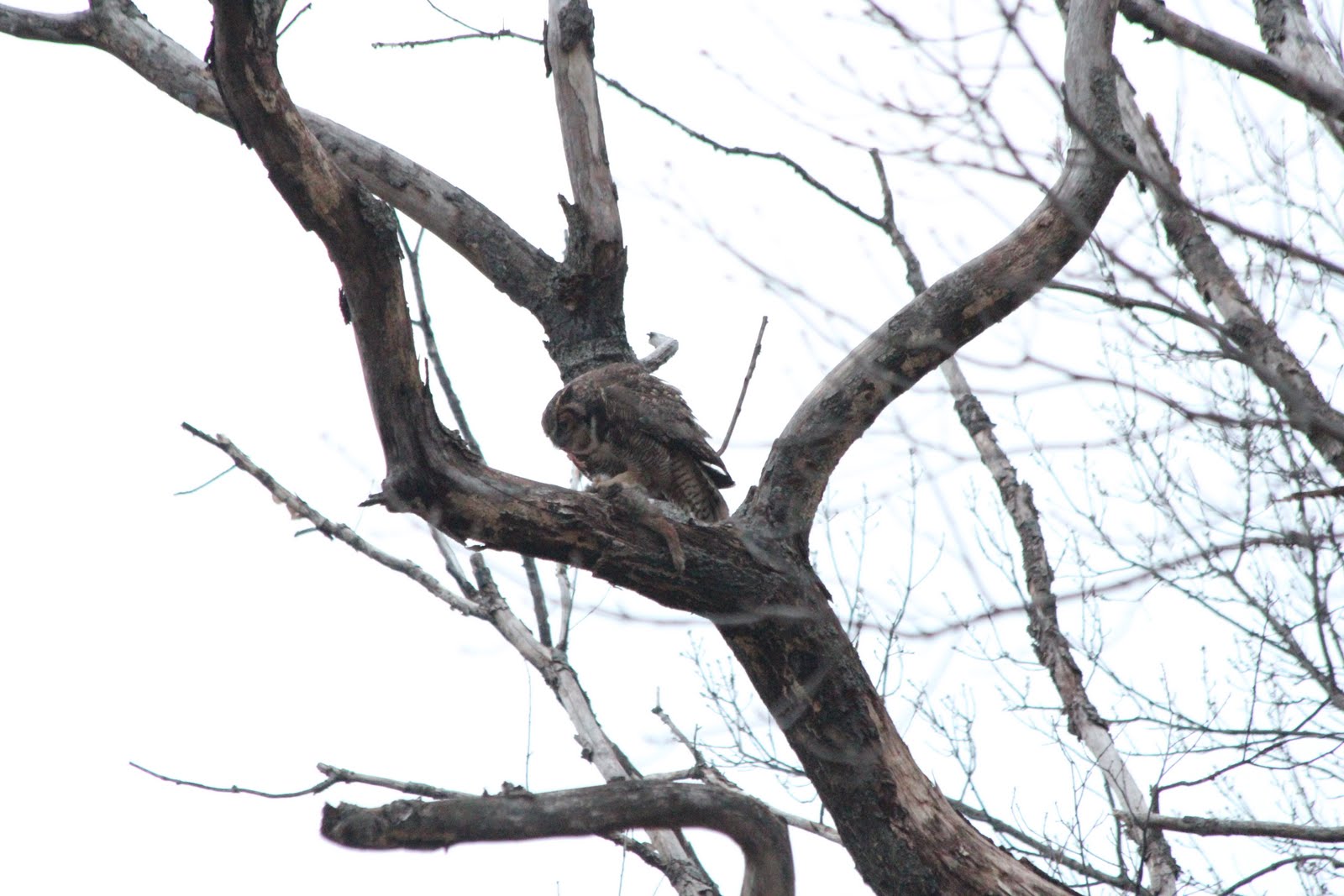
I quickly found Sarah and the owlets. Crows began to mob and Sarah and her youngsters and Charles began to hoot and I found him in his favorite conifer. The mobbing crows eventually departed and the owlets began to beg for food with their raspy begging cheeps. Sarah took flight and landed in The Great Northern Tree. I followed her and began to watch her. I saw her perched on what appeared to be a prey item but I was wrong. Soon after Sarah began looking to the left, to the right, above and below as if she was trying to find something she misplaced. It dawned on me that she was looking for prey that she had cached so that she could feed her hungry youngsters. Sarah even changed positions within the tree to continue looking from new vantage points. I had a front row view of this fascinating behavior. Eventually she flew off right past me. Watch the videos below to see Sarah looking for the cached prey and then flying off again.
Sarah continued on flying towards The Bushy Tree. I came around to the other side of The Wooded Area to find her and like in an earlier post, she had quickly caught another prey item and my initial position was better than my current one. She had flown to The Big Dead Tree with the prey and one of the owlets flew to her side. I headed back around for a better view. I got there to find both owlets but no Sarah. Thinking that she may have gone back to The Great Northern to cache the new prey, I headed that way. I took a few steps and found Sarah roughly between The Big Dead Tree and The Great Northern. She was munching away on the prey she had caught. Even though I had a pretty good view, I couldn't tell what it was exactly but it was a gray, fuzzy bird or mammal. I wondered if she was going to eat a bit of it and then feed the owlets.
Charles began to hoot and his hoots had a real purring trill to them. Sarah responded with a constricted/raspy call I first heard in 2010 nesting season. After hearing this call several times during that nesting season, I was worried that the call was an extreme hunger stress call or that she might have a pellet stuck. Thanks to some great, helpful insight from renown owl experts Jim Duncan and Karla Kinstler, I learned that it is a normal Great Horned Owl call and may well be a nesting female's way of telling her mate that food is needed. Now in 2011, it was interesting to hear Sarah make this call with prey in her talons.
Sarah flew off towards The Middle Conifers and I thought she might be heading there to cache the prey. I reacquired her in a Sweet Gum not far from The Middle Conifers. Both owlets had come over to a tree at the edge of The Wooded Area close to Sarah. They knew she had food. With the prey in her talons Sarah flew over to The Middle Conifers.


Sarah then cached the prey and flew back to the edge of The Wooded Area not far from the owlets. With Sarah in plain sight and only a short distance away, I moved cautiously to get a closer look at the now cached prey. From my research, I know that owls will often aggressively defend cache sites. Biologist Dr. Bernd Heinrich describes cache defense well in his excellent book, One Man's Owl, about a Great Horned Owl that he raised and observed. Thankfully my close approach did not meet with disagreement from Sarah. I could now see the prey item more clearly and that it was a bird of roughly dove size.

Then something amazing happened-the cached prey fell out of the tree down to the grass below! I missed filming the fall as I never expected it to happen but I guess the wind got the better of Sarah's caching procedure. Still moving slowly and cautiously I was able to get a closer look at the bird. I still couldn't tell what species it was (please e-mail me if you can figure it out) but I could clearly see that the bird's head had been removed and eaten by Sarah. Birds of prey often eat the head of their prey first taking in the protein and nutrient rich brain. When the hunting is good, Great Horned Owls are known to eat the brain and leave the rest. It was wild to see the severed spinal cord so clearly.


My time in the park with the owls that night was brief but action-packed and fascinating. Later in the spring my friend, Brenda Hente, saw some more caching behavior by Sarah and it too was in The Middle Conifers. I walked home enjoying a stunning sunset, one of the many great side benefits of watching owls at twilight.

Thanks for reading!
Caching is an instinctual behavior and not a learned one. In his great book, Messages From An Owl, biologist Dr. Max R. Terman describes how his Great Horned Owl, Stripey, began caching prey in the first summer of his life. Stripey did not have a chance to learn this behavior from his parents as he was only four weeks old when taken under the care of Dr. Terman. I've seen very little caching behavior by Charles and Sarah. However, I am confident that it is one of those behaviors that they do and I just haven't been lucky enough to witness it frequently.
The first time I saw caching was in the spring of 2008. That year Charles and Sarah had three owlets; Bart, Lisa and Maggie (after The Simpsons). On this particular afternoon/early evening, I saw Sarah fly to The 07 Nest Tree and disappear into the hollow of this Cottonwood in which she had nested in 2007. Out she came with something brown and mammalian in shape in her talons. She landed in The Great Northern Tree and began to feed on what she had carried. The owlets soon joined her in the tree and she began to feed them. From what I saw, I thought Sarah had caught an Eastern Grey Squirrel when she went to The 07 Nest Tree. I carefully made my way towards them for a closer look. I finally got close enough and saw long rabbit legs and a furry rabbit tail. I realized that unless rabbits were now arboreal (tree dwelling), Sarah had uncached an Eastern Cottontail Rabbit! It was great to finally see this behavior.
In my previous post I wrote about Sarah feeding the owlets (of 2011, Dalton and Monica) an Eastern Cottontail Rabbit on March 31. After feeding much of the rabbit to the owlets, Sarah flew off with the last leg and part of the hindquarters. The next night Sarah flew over to The Middle Conifers. In less than two minutes she was back with prey. Again, my initial thought was that Sarah had caught something. I looked closely at the prey and realized it was the remaining rabbit rations. She had cached it in The Middle Conifers the night before and then uncached it!
While this was great to see the events of April 11 were even more fascinating. It was a blustery day and I only had a relatively brief time to spend with the owls that evening. This became one of those nights when a brief allotment of time with the owls became stretched out further since so much fascinating behavior occurred.
I quickly found Sarah and the owlets. Crows began to mob and Sarah and her youngsters and Charles began to hoot and I found him in his favorite conifer. The mobbing crows eventually departed and the owlets began to beg for food with their raspy begging cheeps. Sarah took flight and landed in The Great Northern Tree. I followed her and began to watch her. I saw her perched on what appeared to be a prey item but I was wrong. Soon after Sarah began looking to the left, to the right, above and below as if she was trying to find something she misplaced. It dawned on me that she was looking for prey that she had cached so that she could feed her hungry youngsters. Sarah even changed positions within the tree to continue looking from new vantage points. I had a front row view of this fascinating behavior. Eventually she flew off right past me. Watch the videos below to see Sarah looking for the cached prey and then flying off again.
Sarah continued on flying towards The Bushy Tree. I came around to the other side of The Wooded Area to find her and like in an earlier post, she had quickly caught another prey item and my initial position was better than my current one. She had flown to The Big Dead Tree with the prey and one of the owlets flew to her side. I headed back around for a better view. I got there to find both owlets but no Sarah. Thinking that she may have gone back to The Great Northern to cache the new prey, I headed that way. I took a few steps and found Sarah roughly between The Big Dead Tree and The Great Northern. She was munching away on the prey she had caught. Even though I had a pretty good view, I couldn't tell what it was exactly but it was a gray, fuzzy bird or mammal. I wondered if she was going to eat a bit of it and then feed the owlets.
Charles began to hoot and his hoots had a real purring trill to them. Sarah responded with a constricted/raspy call I first heard in 2010 nesting season. After hearing this call several times during that nesting season, I was worried that the call was an extreme hunger stress call or that she might have a pellet stuck. Thanks to some great, helpful insight from renown owl experts Jim Duncan and Karla Kinstler, I learned that it is a normal Great Horned Owl call and may well be a nesting female's way of telling her mate that food is needed. Now in 2011, it was interesting to hear Sarah make this call with prey in her talons.
Sarah flew off towards The Middle Conifers and I thought she might be heading there to cache the prey. I reacquired her in a Sweet Gum not far from The Middle Conifers. Both owlets had come over to a tree at the edge of The Wooded Area close to Sarah. They knew she had food. With the prey in her talons Sarah flew over to The Middle Conifers.


Sarah then cached the prey and flew back to the edge of The Wooded Area not far from the owlets. With Sarah in plain sight and only a short distance away, I moved cautiously to get a closer look at the now cached prey. From my research, I know that owls will often aggressively defend cache sites. Biologist Dr. Bernd Heinrich describes cache defense well in his excellent book, One Man's Owl, about a Great Horned Owl that he raised and observed. Thankfully my close approach did not meet with disagreement from Sarah. I could now see the prey item more clearly and that it was a bird of roughly dove size.

Then something amazing happened-the cached prey fell out of the tree down to the grass below! I missed filming the fall as I never expected it to happen but I guess the wind got the better of Sarah's caching procedure. Still moving slowly and cautiously I was able to get a closer look at the bird. I still couldn't tell what species it was (please e-mail me if you can figure it out) but I could clearly see that the bird's head had been removed and eaten by Sarah. Birds of prey often eat the head of their prey first taking in the protein and nutrient rich brain. When the hunting is good, Great Horned Owls are known to eat the brain and leave the rest. It was wild to see the severed spinal cord so clearly.


My time in the park with the owls that night was brief but action-packed and fascinating. Later in the spring my friend, Brenda Hente, saw some more caching behavior by Sarah and it too was in The Middle Conifers. I walked home enjoying a stunning sunset, one of the many great side benefits of watching owls at twilight.

Thanks for reading!




 Posts
Posts


